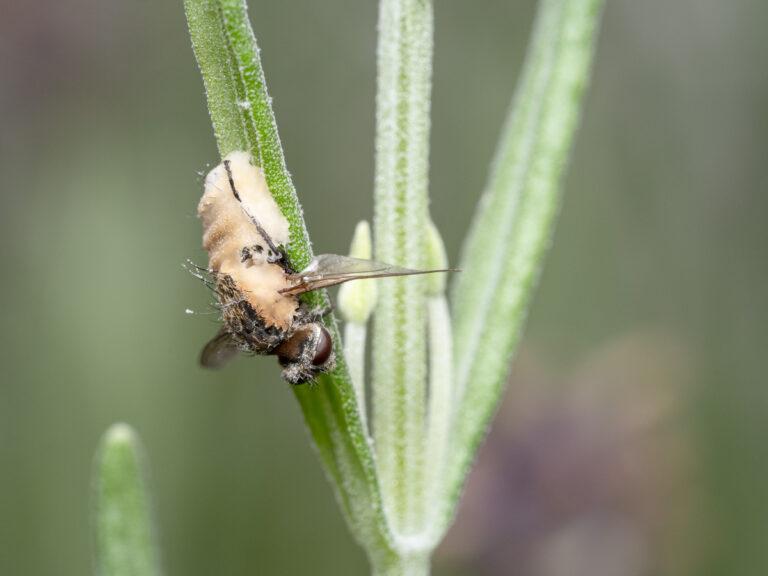
This fly I discovered on my lavendar plant over the summer may possibly have been a hoverfly, although it’s difficult to tell. What is clear is that this individual was overtaken – and likely killed – by fungus.
Fungus is strange. It does not sit neatly within the framework we’ve created to classify all the various organisms on the Earth. Despite common perception, fungus is not a plant; it is not an animal either, but an in-between organism (although somewhat oddly, it does lean more toward animal than to plant).
I lack the insight to offer any identification more specific than just “fungus,” although I recognized this situation when I saw it, having read about other similar fungus, particularly a species that attacks ants. It might be a stretch to say that a fungus preys on ants, and it might be more accurate to say it infects them – but whatever termonology we choose, once invaded, the ant’s body is consumed from within by the fungus, which reaches tendrils into the ant’s brain.
This infection is sometimes referred to as “zombie ants” for this reason, as the fungus influences the ant’s behavior and drives to abandon safety and climb as high as possible before its body finally fails. There, clinging to a branch or tall stem, the fungus bursts out through the ant’s carapace and fruits, spreading its spores on the wind.
Is that precisely what happened to this fly? I cannot say for sure, but the outcome appears similar, with the fly’s remains stuck to a tall stem and enshrouded by fungus. It was an uncommon discovery within my garden, and a bit unsettling that invisible spores can be so deadly to a create several orders of magnitude larger than themselves.