
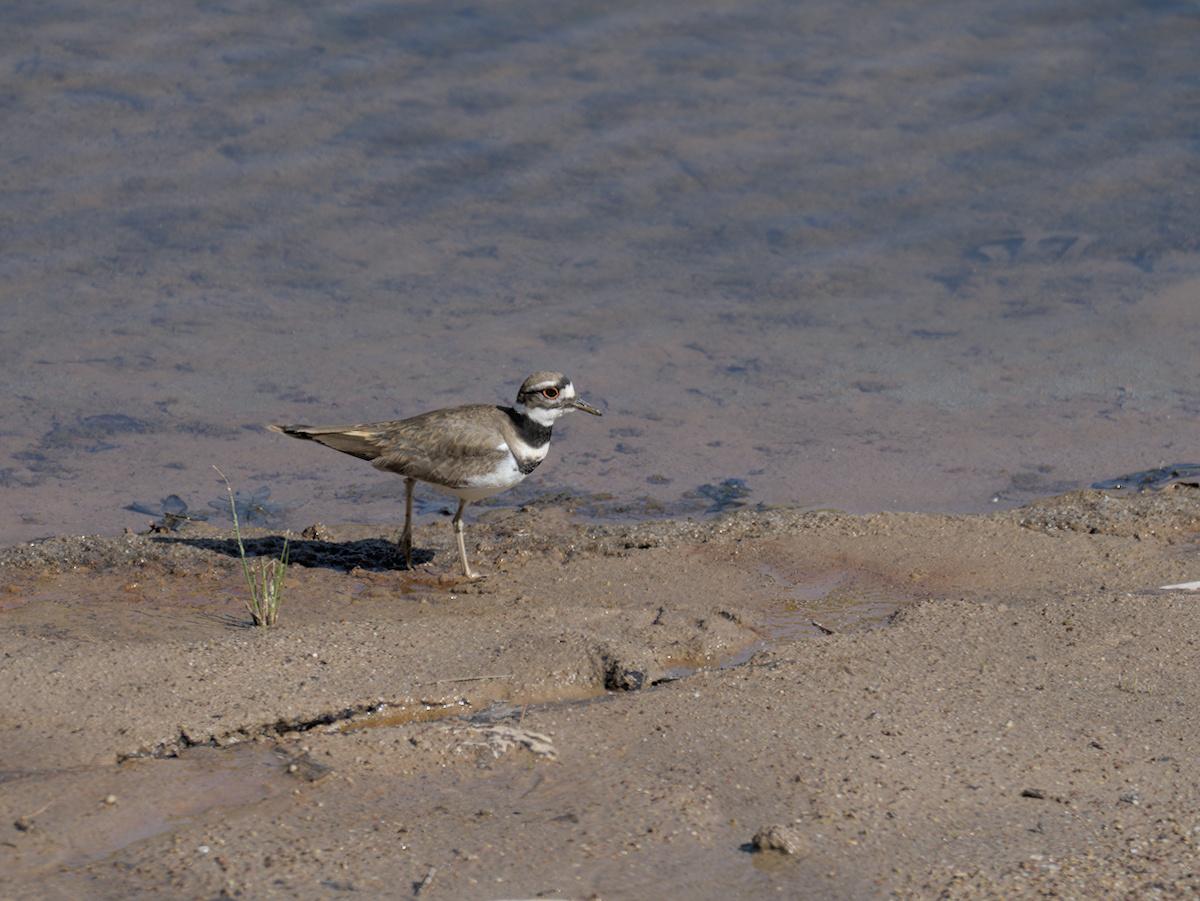
Killdeer used to be abundant in the spring and early summer, the focus of much of my early wildlife photography not only because they are photogenic, but because they were available and approachable. While killdeer are skittish, during their nesting season they are also committed to their nests, and will linger nearby and attempt to lead interloping predators and photographers away, sometimes with the artifice of their well-known broken wing display. And then, at a distance deemed safe, the theatrical killdeer will spring into the air with a chorus of peeps and cheeps and fly away.
If you are at all familiar with killdeer, then you’ll know that referring to their nests as such pushes that term to its very limit, perhaps even more so than with doves, which have attained recent internet fame for their “two sticks counts as a nest” approach. Killdeer nest on the ground, with a preference for areas with dirt and stone, and minimal vegetation. Their “nests” are minimal depressions with perhaps a few stones kicked together. However, their speckled eggs blend into this landscape very well, and since there isn’t much of a nest to see, it is surely more difficult for predators to spot in general.
Several local parks used to have gravel parking lots, which exactly met the specifications for nesting killdeer…aside from the whole “cars running things over” part. Usually I would find them nesting at the fringes, just where grass and other vegetation was loosely growing into the gravel. These nests had the added benefit of being easily observed from within my car, once I located them; where birds, and most wildlife, see a human on foot as a possible threat, they are much less wary of an automobile, which the savvy photographer can use as a sort of mobile blind in these cases.
Most of these parking lots have been improved over time. I use that term loosely, because laying down pavement may be an improvement for cars, but for little else – pavement holds heat, in generally impermeable to rain, and its component materials will remain on the landscape basically forever, to name but a few downsides. And for the killdeer, it removes nesting terrain, forcing them to find suitable places elsewhere.
The killdeer pictured above clearly isn’t in a parking lot, but I did find him at Nescopeck State Park, along the waterline of the drawn-down lake. This was my first killdeer of the year, and he was slightly to distant for a truly good photo, but I was still pleased to see him and grabbed a few shots as he scouted the water’s edge.